
Monthly Archives: December 2007

Dousing the lights at another daily newspaper

tn_cincinnatti.jpg 

The Scripps Center evicts its flagship paper

Midnight on December 31, a story that is more than a century old will end when E.W. Scripps closes the Cincinnati Post, the newspaper currently housed in it headquarters pictured above. If you want poignancy, read the sweet obit that Joe Strupp wrote for Editor & Publisher, but I find that moist eyes contribute to muddle-headed (not muggle!) thinking so let me put this long-expected closure into context.

The Cincy Post, and its sister paper, the Kentucky Post, are afternoon dailies. For the past 30 years the shrinkage in newspaper circulation has generally affected afternoon papers more than morning papers. Over the recent decades newspaper owners were able to persuade lawmakers to legalize the collusion between morning and afternoon newspapers. They were allowed to form Joint Operating Agreements or JOAs that allowed them to share one printing plant, ad sales staff and other production expenses. In return the deal was that the two papers kept separate editorial staffs and therefore more points of view on local issues, at least in theory. And the two papers split revenues according to whatever formula they made. In general, the morning papers became stronger as lifestyles changed, and the factory jobs that got people home in the early afternoon to read the late daily started to evaporate and, with that change, the morning papers became the stronger part of the JOAs

Over time these JOAs (list and details) have been unraveling as the strong papers cuts the weaker papers off from this artificial revenue-sharing lifeline. Three years ago Gannet told Scripps it was cutting off the Cincy Post. Scripps decided to close the paper when the agreement ends at midnight on December 31.

Sad though that might be, shutting the money-losing paper was a smart business play for Scripps, which has been a leader among newspaper chains in reinventing. In October, E-Commerce Times reported that:

EW Scripps announced a plan to split into two separate public companies: one for national media efforts and the other for local and community brands . . . Scripps Networks Interactive, with 2,100 employees and annual combined revenue of about US$1.4 billion . . .  including HGTV, Food Network, DIY Network, the Fine Living Television Network and Great American Country . . .  Shopzilla and uSwitch . . . (and) . . .  EW Scripps, with 7,100 people and combined annual revenues of about $1.1 billion, would encompass Scripps’ 17 daily and community newspapers; 10 TV stations, the United Media character licensing and feature syndication businesses and Scripps Media Center in Washington, which includes the Scripps Howard News Service.”

It takes 7,100 people to make $1.1 billion at the old media E.W. Scripps. It takes just 2,100 people to book $1.4 billion in sales at the new media sites at Scripps Interactive. Sobering, isn’t it.

An unhappy note for a Friday, perhaps, but I thought it a necessary follow to yesterday’s blog post about the analyst who thinks newspaper stocks are undervalued.

Contrarian analyst likes newspaper stocks

tn_falling_knife.jpg

Stocks down 46 percent in 5 years while profits flat. Buy sign?

Don’t try to catch a falling knife! I’ve heard that from investors leery of buying stocks, much less industries, in decline. And there is a buggy whip aroma around newspaper and other mass media stocks these days, what with the Internet gobbling up advertising and the mortgage crisis pushing the economy toward recession.

Against this backdrop, Credit Suisse financial analyst John Klim has issued a contrarian analysis suggesting that publicly traded newspaper stocks in the United States have been excessively punished by investors who cannot imagine the upturn that he anticipates circa 2009. In brief, Klim thinks the general economy will rebound by then, like the tide that lifts all boats, and that newspapers will continue their ongoing transformation into multi-media delivery platforms. For more on Klim’s report see Joseph Weisenthal’s summary in Paid Content.

My take? I’ve been a business reporter for 15 years so I have a vested interest and/or experience at watching industry cycles. Plus I am a born contrarian. Taking those factors into account Klim’s analysis of the financials makes sense to me. The herd always runs too far, and at some point creates the buying opportunity for those willing to buck the trend. But back to the falling knife, I think it’s more likely that these stocks will get hammered more in the short term owing to the likelihood of a poor year-end for the U.S. retailers and thus advertising. If you’ve been sniffing around for a buy sign I’d say watch the herd for a while longer, then then jump in early in 2008 with a strategy of accumulating slowly because the knife is likely to continue to fall throughout the year, testing your resolve in what I suspect is a three to five year bet.

So I am reasonably confident that newspapers will rebound financially. I am far more pessimistic about the quality of newspaper journalism, which I consider to have been on a steadily declining slope throughout my adult lifetime. My favorite peeve, of course, is the complicity of newspapers in spreading misinformation, if not lies, about WMDs that led the United States into Iraq. But I’m also of the opinion that the media, led by its news “muscle” in daily journalism, pumped up Internet stocks in the late 90s, then touted housing in the aftermath of 9/11. Until and unless journalists admit that they have failed to perform their watchdog role, that they have become the Monday Morning Quarterbacks of public affairs, there is no hope that they will fulfull the mission that is the myth of their craft and the motivation of curmudgeons like me.

The irony of secret choices that rule free people

In 1960 the English author and physicist C.P. Snow delivered three lectures titled, “Science and Government,” about the rivalry that hobbled British science during World War II. The hero is Sir Henry Tizard, who led the effort to develop radar and brought Americans into the effort. The villian is F.A. Lindemann, personal friend and scientific advisor to Prime Minister Winston Churchill – aka the Prof and the P.M. — who come across as a pair of buffoons.

Speaking at Harvard not long after both men had died, Snow described Tizard as the son of a naval officer who would have served himself but for bad eyesight. “He was English of the English,” Snow writes.

The German-born Lindemann, by contrast, emigrated to Britain by choice. Snow paints him as “an extreme and cranky vegetarian, who lived largely on the whites of eggs, Port Salut cheese, and olive oil,” adding, “So far as is known he had no sexual relations.”

Ironies abound. Tizard leads the successful program to develop and deploy radar and, pushes the technology into the Royal Air Force in less than six years time. Are we surprised that he worked under the appeasement prime ministers who preceded Churchill? Snow notes that pre-war British hawks, in whose ranks he counts himself, wanted Churchill to take office but once he does, British science policy starts veering toward the nearly fanatical bent of Lindemann who, despite his vegetarianism, pushes war policies that end up cooking a lot of flesh — the human flesh of the German civilians whom he deliberately makes the target of a British strategic bombing campaign from March 1942 through September 1943. Speaking in 1960, Snow says:

“The English and Americans had, for years past, believed in strategic bombing as no other countries had . . . Bombing had become a matter of faith . . . The bombing must be directed essentially against German working-class houses. Middle class houses have too much space around them and so are bound to waste bombs; factories and ‘military objectives’ had long since been forgotten . . .”

Lindemann’s policy of making war on civilians accelerates the drift toward total war a notion that begins to arise during the American Civil War. In a total war everyone and everthing becomes a target in the effort to break a nation’s will to fight.  Hitler had, of course, thrown some nasty first punches in this regard to provoke the British but this does not let them off Snow’s hook.

“What will people of the future think of us? . . . that we were wolves with the minds of men. Will they think that we resigned our humanity? They will have the right?”

Would that it were so! Alas humanity seems to have fogotten this whole discussion, or at least we affluent Homo Sapiens of the West who profess to be baffled as to why bearded men in Iraq might want to blow up school bus to destabalize an occupation government. It’s because they don’t have the aerial bombers like Lindemann!

But I digress.

I read “Science and Government” to try and understand the sad perversion of empiricism by the current United States government whose sins in this regard are so numerous as to obviate the need for me to draw up a bill of attainder.

In describing how British science went so awry during World War II, Snow attributes this to a failure in what he calls the three forms of “closed politics” – the jockeying for power that does not involve a play to the peanut gallery. These three forms are:

  • committee politics, familiar to just about anyone who has ever coached soccer or joined any organization;

  • hierarchical politics, which is part of the drill in getting a Ph.D. or a job at any corporation or non-profit; and

  • court politics, which we know well from watching others shameless suck up to the boss.

And here is the supreme irony: we think of ourselves as living in an open and democratic society and, indeed, we can debate till world’s end whether men should be allowed to marry men, and women to wed women, or whether doctors can legally use forceps to crush the skull of an eight-month-old fetus because the mother says to bear the child would be negatively affect her mental health. But less so war and peace because such decisions are made in small rooms. Or as Snow says to open his lecture:

“One of the most bizzare features of any advanced industrial society in our time is that the cardinal choices have to be made by a handful of men: in secret . . . And when I say ‘cardinal choices’ I mean those which determine in the crudest sense whether we live or die . . .”

(I have a point, I promise, which I hope to pick up tomorrow, but this morning the refrigerator is barren, and I am the commandant of shopping; time is short and my duty is clear.)

North American ad sales growth lags world totals

tn_world-ads.jpg

Global ad spend recap, forecast reflect U.S. mortgage doldrums

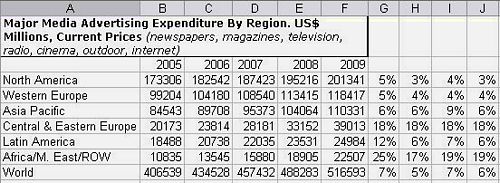
ZenithOptima, a division of the global advertising firm Publicis Group, has released a free summary of a global advertising report that reveals many of the same trends apparent in the United States — the rapid loss of ad sales by newspapers and radio; a mild uptick in television and outdoor ad spending; and continuing strong growth of Internet advertising (click here to read) summary.

I chose one of the charts (see above) and ran it through a spreadsheet to see the comparative growth rates, historical and projected. The percentages shown on the right are from my calculations.

As would be expected North American, the largest market, grows the slowest, versus the emerging advertising frontiers in Central Europe or Africa, the Middle East and ROW (rest of world?). Of course there may be issues with the water in some of these rapidly-growing geographies.

One of the reasons I parked this number here is that at some future date I want to figure out whether global ad spending matches the ratio I have previously computed  for the U.S., of roughly 2.2 cents of advertising for every dollar of Gross Domestic Product. I just don’t have world GDP handy and don’t have time to look for it today.

Meanwhile, if you have another moment to spare, this Economist article solved one mystery about Internet advertising, only to create another. The piece, “Many ways to skin a cat,” explains why previous Web advertising metrics such as hits and page views are passee as measures of effectiveness (hits inflated activity because every graphic registered; page views had been a better choice but the AJAX technology of Web 2.0 weaken it as a measure).

The article goes on to talk about new measures in the works, such as time spent with media, and it struck me that the Internet ad sellers have no firmer idea of the effectiveness of their message delivery than their mass media predecessors. They simply have more meaningless metrics in their sales kits because everything is trackable on the Web. That doesn’t mean the numbers reveal any useful trtend. But if you are an ad buyer at a major brand those numbers must tell you that nobody gets fired, nowadays, for moving a larger share of their budget to the Internet.


Untethered! Verizon EV-DO beats cable, DSL

tn_untethered.jpg 

Verizon EV-DO lets me blog damn near anywhere

I am blogging for the first time using my new Verizion EV-DO service, a 800 kps to 1.4 megabit per second service delivered through a cellular modem (provided). So for the same $59.99 per month that I now pay for Comcast I will get comparable speeds, anywhere in Verizon cell country. Comcast supposedly delivers higher speeds but as their customer for seven years or more I rarely if ever got that speed. When I shopped the Verizon store yesterday the values were unreal. I for four of the EV-DO cards, normally a $170 purchase, for the cost of the sales tax! So now all the adults in my family will have untethered access. I also got a rather simple cell phone (an LG, a South Korean make, I believe) and the two year contract for that service (as with the EV-DO) in this case for $40 (450 minutes). I got the phone and the Verizon service because both come highly recommended by Consumer Reports. There is a tiny tale with the phone decision. I had been using an ATT Tilt, one of these new-fangled all-in-one do anything devices. But the Web access (thru the Cingular network) was rage-inducing slow. So I cancelled that, and I did not try the GPS or the other fancy features so what was I left with — a costlty, heavy gadget that I could not easily use for calling in or out or even seeing what day and time it was! So that went back in the box. Now with the ED-VO service my plan is to get, as soon as money permits, the lighest full-function PC laptip (or a Mac, but they are now 2-times the cost of PCs!!!). I’m thinking the battery life is a key; also quick booting and travel ready. This way I carry the PC and the cell and I am in business everwhere that Verizon takes a signal. I am pleased. That I was able to get the type of service to fit my needs and at a price I can afford. Oh, did I forget to mention: I will register today for a price break on the Verizon service through my employer’s discount program. Sweet! But not as sweet as when I write Comcast to cancel their crappy and costly broadband that never delivered on its promise. I will try to be polite.

Stop the presses! Ink jets print news!

tn_printing-press.jpg 

Can high-volume ink jets compete with the rotary press for short runs?

The rotary press is one of the familiar icons of newspapering because it is the formative technology upon which the mass market daily has been built. Invented in the mid-19th century, it offered the ability to produce large runs at low cost, enabling newspaper pioneers like Joseph Pulitzer to design more eye-grabbing pages at prices affordable to the working stiff and modern newspaper journalism was reborn.

More than a century later the newspaper suffers a terrible cost disadvantage vis a vis the Web as an audience-getting medium, and many wonder whether paper is passe as a presentation vehicle for news.

Against this backdrop Poynter Institute editor Amy Gahran writes about the emergence of high-volume, low-cost inkjets. Her blog is based on research done by newspaper consultant Vin Crosbie who talks about Short Run Digital Printing (SRDP) systems from Kodak U.S.A., Océ of Belgium, Fuji Xerox in Japan, and Agfa in Germany. He writes:

“For example, Agfa’s Dotrix duplex press can print 30,000 tabloid (A4) sized, four-color editions per hour (500 pages per minute). This newspaper press cost about one-quarter what a plated presses does and requires only a single person to run . . .  (but) . . .  inks for SRDP presses cost much more than those for plated presses . . .  (and) are now economical to purchase and operate only for daily newspapers of less than about 10,000 circulation — although that number is expected to double within two years and continue climbing. This would make SRDP presses economical for about 400 of the 1,450 U.S. dailies today, and double that by 2010.”

Gahran makes the following observation which I share wholeheartedly:

“What if, instead of relying on larger, centralized printing plants and expensive transportation networks for physical distribution of printed papers, newspapers (even big dailies) instead relied on much smaller, more geographically distributed printing plants closer to the papers’ final destinations?”

Short run printing opens up the sort of game-changing possibilities for newspapers that the rotary press afforded Pulitzer and his cohort. Only now the direction is reversed. Now the world wants niche or personalized news . . . and while it remains to be seen whether this technology or something like it will extend the lifespan of print and allow it to compete with the infinitely customizable web, I think the answer is yes. Convenience, disposability and graphic appeal will, I think, continue to preserve a place for printed communications . . . making the only question whether newspapers can make the cultural shift necessary to decentalization.

Over the last 100 years newspapers have become massively centralized behemoths. Media moguls want to merge and create bigger monoliths, that would include radio and television stations (see cross-ownership debate for more). Yet I think that modern life demands that big institutions be broken into smaller bits. And here is a technology for accomplishing that in print. Now that Gahran and Crosbie have brought it to my attention, I will look for more on this production breakthrough.

P.S. In looking for background on Crosbie I found an article he wrote  for OJR.com in 2004 that makes this observation abiut the switch from mass to customized manufacturing: “continued mass production of generic products is as dead or dying a concept as powering presses by steam.” Amen!

Nokia redefines mashups: circular entertainment

Nokia must be doing something right. The cell phone maker is a leader at the cutting edge of electronics, the distribution and servicing of handheld electronic  devices. So when it publishes a study, “A Glimpse of the Next Episode,” it seems wise to assume that the report is somewhat self-serving and that the company has released that which it wants us to know and kept back some of the spice it discovered so as to better mix its own secret sauce.

That being said, Nokia predicts that within five years, one-quarter of entertainment “will have been created, edited and shared within their peer circle rather than coming out of traditional media groups.” In short, life will be a big mashup, viewed often no doubt on mobile devices.

I found two distillations of the Nokia findings (from MobileCrunch and Daily Connect) but not a link to the report.  And unless I glossed over it in my reading, I don’t know how the survey arrived at the 25 percent figure — by dollars spent, bytes transmitted or elapsed time of perusing what fruits arrive from the entertainment shift. (We are told that 9,000 persons were involved in 17 countries.)

But I’m not hung up on the numbers. What strikes me as interesting and plausible is the direction in which this study leads our thinking. We all add a little top spin when we tell a story. We add an adjective or a frown to indicate what we think about whatever — to influence or impress our listeners. What Nokia is talking about is the technological equivalent. Say you’ve just downloaded an interview with a celebrity you love or detest. What if you could add a halo or a pair of horns over the head and pass it to a friend? Isn’t that what the Web is about? Take the peer-conscious nature of youth culture; provide a device to easily share thoughts and impulses; and a way to modify the original content. And you have the making of many minutes of merriment. Wanna put your girlfriend’s head on Lindsay Lohan’s body? Can do. What fun!

Well, not for me but then that is the point. I belong to the generation who read. Soon I will put my false teeth into the cup beside my bed and not long after that me and my cohort will die, leaving behind many problems from a warmer world to the nettlesome issues of how to accommodate this playfulness. For instance, will Nokia be responsible for allowing the proliferation of softwares that would make it easy, for instance, to alter copyrighted text? Or will it close its platform to such alterating effects and insist that mashers do their mashing on other devices and only deliver their copyright infringements over Nokia’s net? Or maybe the copyright fundamentalists in Hollywood will get over their bad selves and allow that the universe of fair use must expand? Why are you shaking your heads? It could happen.

One last thought along these lines is aimed at Americans. Today we imagine ourselves the center of popular culture and that may be true, especially as regards movies and perhaps music — pop culture is hardly my forte. But as in every other realm of affairs any U.S. advantage is evaporating more rapidly than the worth of the dollar. Nokia, for instance, is based in a country that clings by its fingernails to the appelation of being a Western nation. And many of the insights and trends that will influence this mobile, mashup world of “circular entertainment” are already coming from Asia, notably trendy Japan and hot-on-its-heels South Korea.  

Here’s one last kick in the ass to American complacency: this study was done for Nokia by a UK outfit called The Future Laboratory. I visited its web site this morning to see who are these hot zeitgeisters and I learned that they have a patented form research called “cultural triangulation.” What  is that? Why they ask questions, watch the respondents and then use their intuition! Can you imagine that? All three human actitivities performed by one market research firm and protected by patents. Why even if anyone else thought of using their ears, eyes and brain all at the same time, they’d be prevented by international patent law. Want to be really impressed. Visit The Future Laboratory web site and watch it load — it’s cool, and I hope they markup their work an extra 15 percent for the entertainment value of that click, over and above the premium already charged for their cultural triangulation patent.