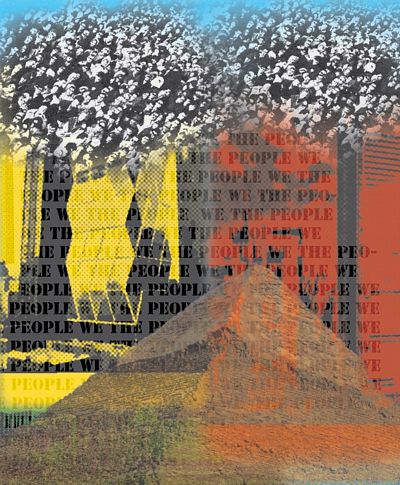
Collage by Doug Millison of NonHuman Communications
In Hollywood everyone has a screenplay. In New York the unpublished novel is the thing. In Silicon Valley, which I’ve covered for most of the last 16 years, it’s all about inventions. So at the risk of sounding like I’ve gone native let me tell you about two magic bullets that could cure the brain death afflicting newsrooms — the editaser and dewhisperfier.
The editaser is a smart stun gun to find and punish editors who assign stories based on stuff they’re read or seen in other media. The dewhisperfier is the antithesis of the cone-of-silence from the 1960s television series, Get Smart. It would force rank-and-file journalists to complain out loud and generally behave like the heroes of newspaper epics such as His Girl Friday, or Inherit the Wind, or The Paper.

Before I proceed let me correct any misconception that I am talking about the paper from which I am currently on vacation, and which I consider to be the Lake Woebegone of newrooms, where the editors are wise, the reporters fearless and the copy desk misses nothing.
No I am talking about mass media and I base my worries on two lessons that I learned at the Columbia University J-school (class of ’91) where I will be attending an alumni gathering this weekend.
It was while I was at J-school that ex-New York Times correspondent James Feron gave me the idea for the editaser. Feron co-taught my home room class with science-writing professor Ken Goldstein. One day Feron mentioned that he had a Times colleague who never started an assignment without first sleuthing out from where and whom inside the building the assignment had come. As a reporter I’m trained to recognize the detail or quote that encapsulates the story. Though I wasn’t quite sure at the time what Feron was trying to say I was sure it was what one former editor, Kenneth Howe, called the objective correlative.
Let me pause to explain my protocol on naming names, which I consider a bedrock of journalism that allows a reader or viewer to better assess statements and anecdotes. As I articulate my concerns and suggest reforms for the untrusted and deeply-troubled mass media I will name former colleagues and past incidents, within the bounds of propriety. Current colleagues and issues, however, I deem protected by the obligation of employer and team loyalty. Plus I consider telling tales out of school smarmy.
But I digress. The dewhisperfier was also inspired by J-school recollections of what should have been pep talks by Big League journalists. But their body language showed more pessimism than pep. They whispered and frowned in tete-a-tetes with the profs who had arranged the visits. This head-shaking puzzled me because they had the jobs we wanted and yet . . .
After I got into the corporate world, by which I mean both journalism and the business beats I cover, I realized that I was witnessing Dilbert syndrome — a form of cognitive dissonance that afflicts many professionals, including journalists, who can’t live up to their professional norms and expectations.
Take My Girl Friday whose plot revolves around editor Walter Burns’ zany efforts to keep wise-cracking reporter Hildy Johnson from quitting. What a myth! If a reporter today said, as does Hildy — “I wouldn’t cover the burning of Rome for you! — would Walter say, “Hildy, Hildy, Hildy,” or, “One less pink slip.”?
If newspapering was ever as insouciant as is portrayed in His Girl Friday it isn’t like that today. What kind of film would it be if Hildy was afraid to tell Walter to take his job and shove it. Meeting Walter’s expectations would become her career skill while Walter, basking in her talented yet submissive admiration, would become overly impressed with his own discernment. I would re-title the modern remake The Jayson Blair Project — a tale of the inherent corruptibility of the mentor-protege model.
That was an exceedingly bad manifestation of the archaic way in which we try to make journalism. What ails newsrooms today is too much incentive to look up and too little to look down. We survived Citizen Kane because there were enough Pulitzers and Knights to keep the system in balance. How many media voices are there, now? Not enough. Today’s corporate media are to news in the 21st Century like the condottieri were to war in Renaissance Italy — not terribly skilled, lacking in principle and costly.
The imperious editor, as popularized today by the Spiderman-bashing J. Jonah Jameson, is as useless as Pharaoh. His day has passed. Hierarchies were useful when we need to build pyramids. But an historic change is occurring today. The pyramid is being smothered by “The Cloud” — one of the names used to describe the Internet, that anarchic disruptor of all modern industry.


Sociologists have coined the term “network society” to describe the reorganization of wealth and work that is being driven by this new mode of organization. David Weinberger’s “Small Pieces Loosely Joined” offers a more better metaphor and read. Network society is built around small teams with low overhead and high skills. They just do it while hierarchies convene committees that meets for hours to produce minutes.
It may be a difficult cultural adjustment but newspaper execs have the fix at their fingertips — give every person in the organization the power to publish to a paper-sponsored blog (If you have not already, please glance at my similar statement on this yesterday).
Imagine over time hundreds of people in your organizations spending perhaps 20 percent of their time finding and posting items of interest. Sound like a waste? Unless you’ve shut down their browsers they’re already spending a good part of their days looking at videos, shopping or passing jokes.
Let’s go with the flow and harness some of this curiosity and restlessness. With mild discipline and some training these e-pubs will find niche readers to replace the mass audience that has dissolved into droplets. Newsrooms must draw these thousands of currents inside and then ask editors to do a job they’ll find more fulfilling than attending meetings. They will look into this array of inputs for patterns. Some of these patterns will become stories — and many of blog posts will make briefs, brites and picture boxes. Journalists will form a symbiosis with what ex-newsie Dan Gillmor calls “the former audience.”
Sure media organizations are experimenting with citizen journalism or what investors call “user-generated content” (meaning free labor). Online journalist Jonathan Dube recently described an opinion forum created by New Hampshire Public Radio and a citizen media site created by CNN. I am sure there are other examples of reaching out to readers.
But this must be more than a technology bolted-onto the pyramid. A new way of gathering and disseminating news is here. It will require a change in attitudes at the bottom and the top. Those accustomed to whispering at the base of the pyramid must reach for the clouds. Those at the apex will have to decide whether they love journalism enough to let it go.
I am confident the powers that be will do the right thing. Or perhaps I’m just hoping to keep getting paid vacation like this one. But as a backstop I’m offering open source licensing to anyone wants to help design, build and/or finance my two inventions.
(Note: The title of this posting pays homage to Eric Raymond’s 1997 essay, The Cathedral and the Bazaar, about Linux, a prime example of open source software development. Thanks also to print journalist turned blogger Tom Foremski who helped me realize that journalism is an open source activity. Foremski’s posting, “The Holy Trinity, is worth regarding in this regard.)